Internal tools and admin systems
The screens your team uses every day to manage orders, cases, stock or content, in place of spreadsheets and shared inboxes.
When the work outgrows spreadsheets, shared inboxes and off-the-shelf tools, we design and build software around your processes, your people and the systems you already run, so the software fits the work.
Thanks, we’ll be in touch soon.
{{ heroStatus }}
A few of the companies we’ve worked with.
Off-the-shelf software is often the right answer, and we’ll say so when it is. Custom software makes sense when the tools available keep getting in the way of how you work.
Software for the work that’s specific to your business.
The screens your team uses every day to manage orders, cases, stock or content, in place of spreadsheets and shared inboxes.
Secure places where customers, members or partners can see their information, follow progress and get things done without needing to call you.
Planning, booking and dispatch systems that bring live information together and leave the final decision with the person responsible.
Rules that turn a request into an accurate quote or configuration with every price broken down, so nobody has to assemble it by hand.
Requests, reviews and sign-offs that move through the right people in the right order, with a record of every decision.
Views of your own data that answer the questions your team actually asks, drawn from the same records the work happens in.
For companies launching software of their own: the product, its accounts and billing, and the platform it runs on.
We start with the work, not the screens.
We sit with the people who do the work, follow the information from where it starts to where it ends up and note every workaround along the way.
The riskiest pieces, such as a complex rule, a difficult integration or an unfamiliar group of users, are prototyped and tested before the rest is built.
Working software reaches a small group early, then widens as it proves itself. Each stage is reviewed with you before the next begins.
We document the system, train the people who run it and agree how it will be supported: by us, by your team or by both.
The screens are only part of it. These decide whether a system still works well years after launch.
Each person sees and changes only what their role allows, down to individual records where needed.
Every change is recorded with who made it and when, so questions can be answered and mistakes put right.
Rules, lists, templates and content can be updated by the people who run the system, without waiting for a developer.
Reporting reads from the records the work happens in, so the figures match what people see on screen.
Exports and a documented API keep your information available to you and to your other systems.
New software rarely starts on its own. It needs to work with your CRM, finance and ERP tools, identity provider, payment services and data platforms.
We connect to them through their APIs, bring existing data across carefully, from old systems and spreadsheets alike, and give the new system a documented API of its own, so the next connection is simpler.
Business software is often where AI earns its place: turning an incoming document into a record, drafting a reply for someone to check or finding a record by describing it. We build it in with the same permissions, testing and review as the rest of the system.
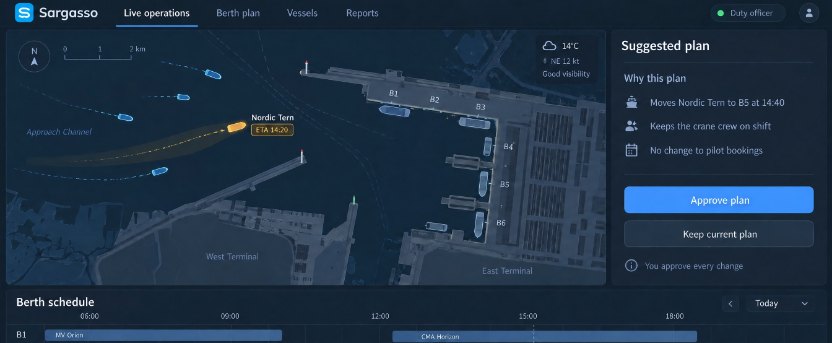
A port operator was resolving berth conflicts on whiteboards and in message threads, and losing time to it every week.
Live vessel tracking, arrival predictions with confidence ranges, an optimizer that tests berth plans and a copilot for scheduling questions. Every plan shows its reasoning, so the duty officer stays in charge.
The whiteboards and the message threads. The office and the quayside crew now work from the same plan, the crew through a companion app.
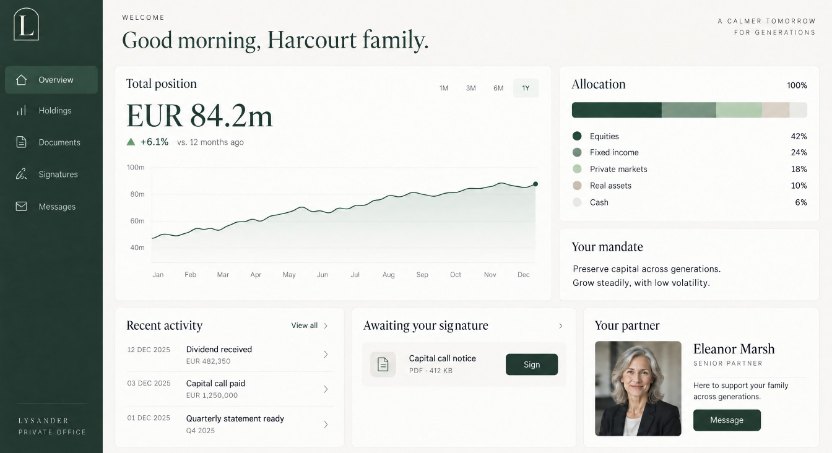
A private reporting portal that gives each family its position and allocation, its mandate in plain language, its statements and signatures in one place, with its partner a tap away.
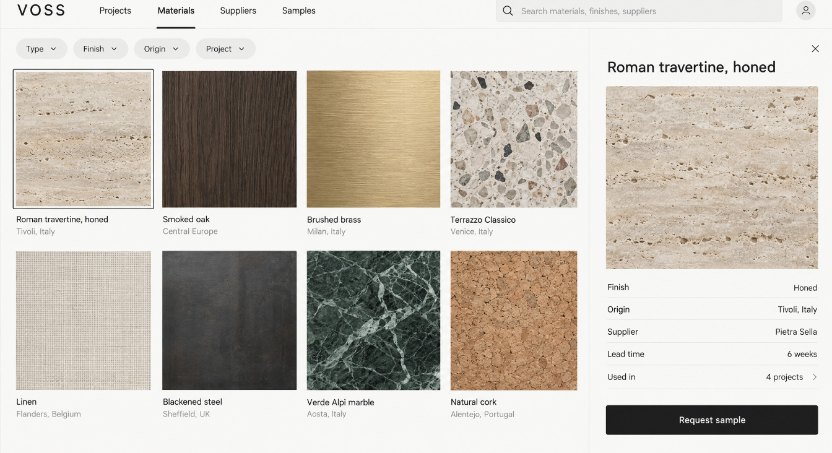
An internal library of every material the studio has specified, searchable by type, finish, origin and project, with suppliers, lead times and sample requests.
Business software is used every day, often for years. We can host, monitor and maintain what we build and keep improving it with you, or hand it to your team with the documentation and the knowledge behind it.
Work with us as a dedicated team, on a fixed price project or a mix of both.
How each is paid for: Pricing
Already running custom software that’s become hard to change?
Legacy modernizationTell us about the process, the workarounds and the systems involved. We’ll give you an honest view of whether custom software is the right answer, and a sensible first step.
Thanks, we’ll be in touch soon.
{{ ctaStatus }}