

AI inside the screens
your users know
We design and build AI features inside your product, such as search, summaries and drafts, tested before release and measured by what your users do with them.
Thanks, we’ll be in touch soon.
{{ heroStatus }}
You’re in good company
A few of the companies we’ve worked with.
{{ wallSay }}
More than a good answer
A model can write a good summary on its first try. Making that a feature means deciding where it appears, what it may read, what it does when it’s unsure or the provider doesn’t answer, what each use costs, and how you’ll know it helps. Those decisions are the engineering, and they’re what your users notice.
Here, the model is the AI that reads or writes, and the provider is the company that runs it.
What we build
AI features inside the screens your users already know, with a person in charge of what each one does.
Search by meaning
Results that match what someone means, across your product’s own content, showing only what that person can open.
Summaries with their sources
Long threads, records and documents in a few lines, each line linked to the part it came from.
Drafts a person sends
Replies, descriptions and reports drafted in place, for the person to edit before anything goes out.
Details read from uploads
Fields filled in from a document or a message, for the person to check before they’re saved.
Suggestions with their reasons
Next steps and sensible defaults, each with its reason shown beside it.
Incoming work sorted
New items tagged and routed, with anything the model is unsure of left for a person.
A conversation with customers or staff? AI Chatbots & Assistants →
Work that moves across your systems? AI Agents →
Models trained on your own data? Data Platforms & MLOps →
Engineered like the rest of your product
Each feature gets the care any part of your product gets: who can see what, how it reads for everyone, what happens when something it depends on fails, what it costs, and how it’s tested. We write those decisions down for each feature before it’s built.
Summaries
An example
- Can read
- What this person can already open
- Shows
- AI-written text, labeled, with a link to each source
- As it’s written
- Announced to screen readers once it’s done, not word by word
- If unsure
- Says so, and shows the thread
- If the model doesn’t answer
- The thread, as before
- Cost
- A limit for this feature
- Model
- Chosen on your own cases, and can be replaced
- Data
- What’s sent, kept and where, agreed before launch
- First users
- A small group
How we test a feature before it goes live: How to test an AI feature before it launches →
What people do with a draft
A rating asks people for an opinion. What they do with a draft is already on record: they send it as written, edit it first, or set it aside. Each edit shows, in your users’ own words, what they changed. So a feature can be measured by what people do, without asking them anything.
We record which of the three happened each time, and read the edits to decide what to change next. What’s recorded, and for how long, is agreed with you before launch.
An example
Edit it if you like, then send it or set it aside.
Sent as written.
Sent after edits.
removed {{ w.t }}
Set aside. Nothing was sent.
The draft is back as it was.
- Sent as written:
- the draft did its job.
- Sent after edits:
- the edit shows what to change, in your users’ own words.
- Set aside:
- the feature didn’t help this time, and that’s worth knowing too.
Our work
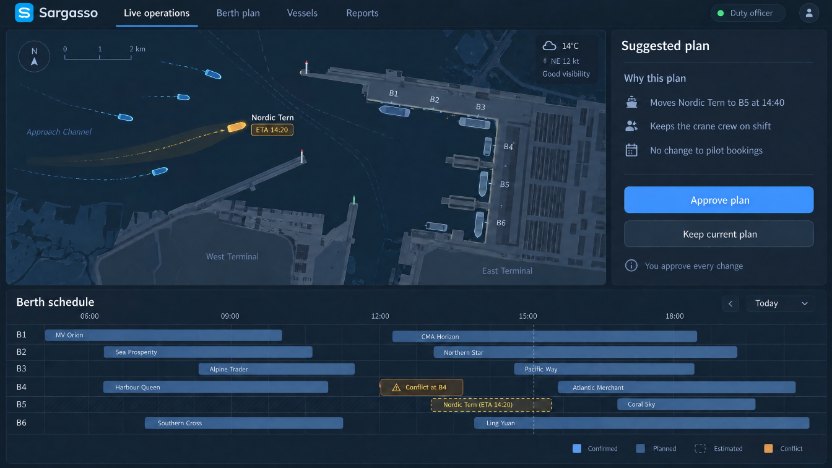
Every plan shows its reasoning, so the duty officer stays in charge.
Sargasso Port Intelligence
A berth-planning system combining vessel tracking, arrival predictions and scheduling support, with the duty officer in control of the plan.
Start with one feature
We pick one feature your users will notice and build it into the screen where the work already happens. It goes to a small group first. Once it has seen real use, you decide what comes next.
Work with us as a dedicated team, on a fixed price project or a mix of both. Compare engagement models →
How each is paid for: Pricing →
Questions worth asking
Where should AI go first in our product?
In a screen your users spend real time in, on work a model can help with, such as reading long threads or writing the same kind of reply. We look at how your product is used and pick one feature to start.
What happens when it gets something wrong?
Each feature is built so a person can see what it did before it counts. Summaries link to their sources, drafts wait to be sent, details wait to be saved, and anything the model is unsure of goes to a person.
What happens when the AI provider is down?
The screen keeps working without it. Search falls back to matching words, the thread shows without its summary, and the reply field stays ready to type in.
Should we tell users a feature uses AI?
We label AI-written text where it appears. Whether a law also asks for it depends on where your users are and what the feature does. AI Security & Governance →
Can it work with the product we already have?
Yes. Most features sit on top of what’s already there, using the same sign-in and data your product uses. If the data a feature needs isn’t reachable yet, we start there. Systems & API Integration →
Do we have to commit to one AI provider?
No. Each feature’s provider is chosen on your own cases and within your data rules, so two features can use different ones, and a choice can be made again as your needs change.
What does an AI feature cost?
It depends on the feature, the data it works from and the screens it sits in. What each use costs to run is set as a limit before launch. The first call is free. Your proposal sets out the scope, the price or rate, and how you pay, before any work starts. Pricing →
Let’s ship it better
Tell us which screen your users spend the most time in. We’ll suggest a first feature.
Thanks, we’ll be in touch soon.
{{ ctaStatus }}